Introduction
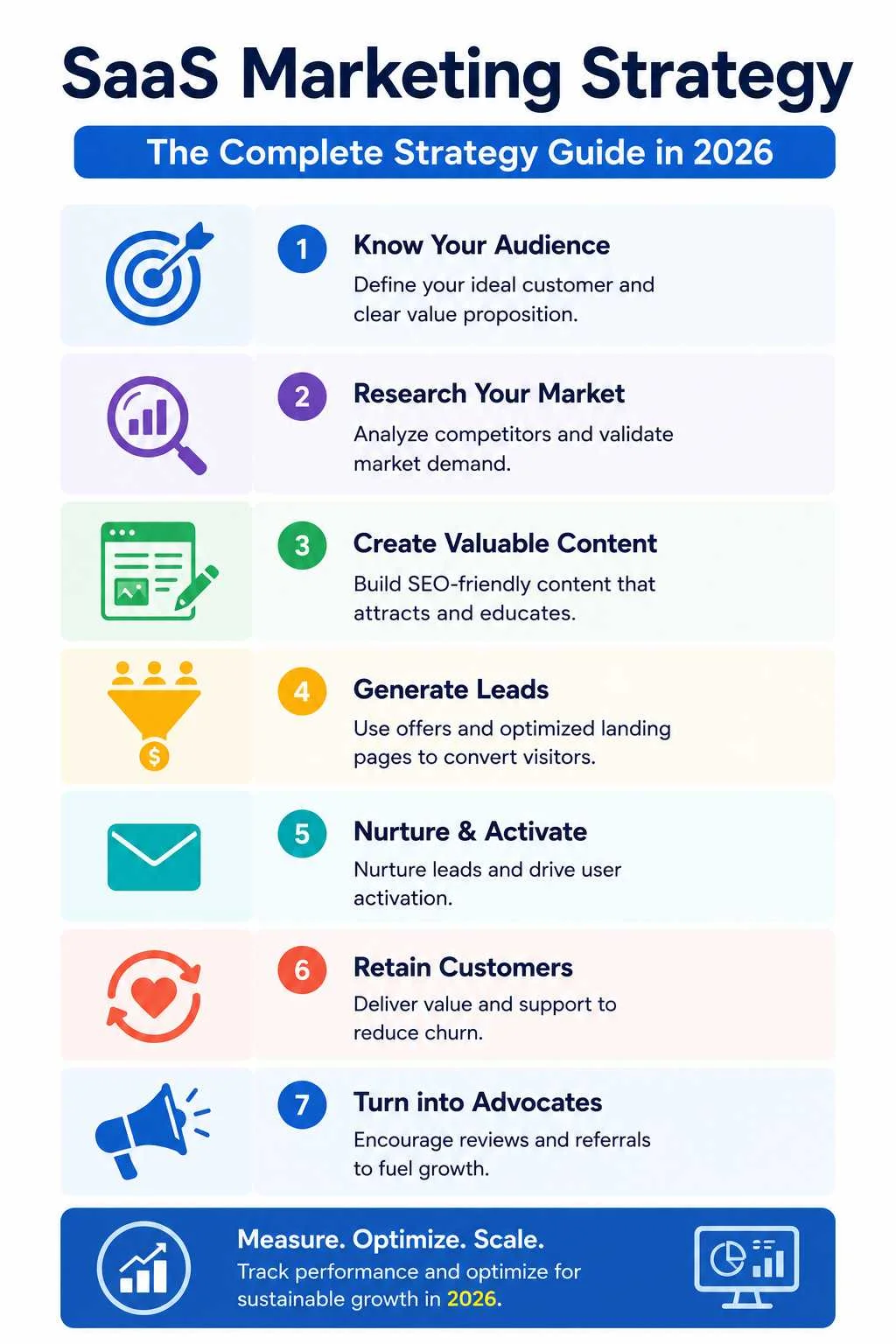
Software as a Service (SaaS) has become one of the fastest-growing business models in the digital economy. From CRM platforms and project management tools to AI-powered applications and accounting software, SaaS products help businesses operate more efficiently through cloud-based solutions.
Customers usually don’t make an instant purchase. They research, compare alternatives, test free trials, and evaluate features before subscribing. This makes SaaS marketing a unique process focused on attracting, educating, converting, and retaining customers.
In 2026, successful SaaS marketing is no longer just about generating traffic—it’s about creating a complete customer journey that drives long-term growth and recurring revenue.
What is SaaS Marketing?
SaaS Marketing is the process of promoting subscription-based software products to attract users, convert them into paying customers, and retain them over time.
Unlike traditional marketing, SaaS marketing focuses on building long-term customer relationships rather than one-time sales.
Main Goals of SaaS Marketing
- Generate qualified leads
- Increase free trial sign-ups
- Convert users into subscribers
- Reduce customer churn
- Improve customer lifetime value
The ultimate goal is sustainable and recurring revenue growth.
Why SaaS Marketing Stratergy is Important
The SaaS industry is highly competitive. New software products enter the market every day, making it difficult for businesses to stand out.
Benefits of Effective SaaS Marketing
- Builds brand awareness
- Generates targeted traffic
- Improves customer acquisition
- Increases subscription revenue
- Enhances customer retention
A strong SAAS marketing strategy helps SaaS companies grow consistently while reducing acquisition costs.
Understanding the SaaS Marketing Funnel
A successful SaaS marketing strategy follows a structured customer journey.
Awareness Stage
Potential customers discover your software through:
The objective is to attract the right audience.
Consideration Stage
At this stage, prospects evaluate your product and compare it with competitors.
Helpful content includes:
- Product guides
- Case studies
- Blog articles
- Demo videos
Conversion Stage
The goal is to turn visitors into customers.
Popular methods include:
- Free trials
- Live demos
- Free consultations
- Limited-time offers
Retention Stage
Customer retention is critical for SaaS success.
Focus on:
- Customer support
- Product updates
- User education
- Regular communication
Key SaaS Marketing Strategies for 2026
Invest in SEO
Search Engine Optimization remains one of the most effective lead-generation channels for SaaS businesses.
Focus Areas
- Keyword research
- Blog content
- Technical SEO
- Landing page optimization
- Internal linking
SEO helps attract users who are actively searching for solutions.
Benefits of SEO for SaaS
- Long-term traffic
- High-quality leads
- Lower acquisition costs
Create Valuable Content
Content marketing helps educate potential customers and build trust.
Effective Content Types
- How-to guides
- Industry blogs
- Product tutorials
- Case studies
- Comparison articles
- Webinars
High-quality content positions your SaaS company as an industry expert.
Offer Free Trials and Demos
Many users want to test software before purchasing.
Benefits of Free Trials
- Builds confidence
- Demonstrates product value
- Increases conversions
The easier it is for users to experience your product, the more likely they are to subscribe.
Leverage PPC Advertising
Paid advertising can help SaaS companies generate leads quickly.
Popular PPC Platforms
- Google Ads
- LinkedIn Ads
- Facebook Ads
- YouTube Ads
Target users who are actively looking for software solutions similar to yours.
Use Email Marketing
Email remains one of the most effective SaaS marketing channels.
Types of SaaS Marketing Emails
- Welcome emails
- Product updates
- Educational newsletters
- Trial reminders
- Customer onboarding emails
Consistent communication helps move prospects through the sales funnel.
Focus on Product-Led Growth
In 2026, many SaaS companies are adopting a product-led growth model.
This means the product itself becomes the primary driver of customer acquisition and retention.
Product-Led Growth Examples
- Free plans
- Interactive product tours
- Easy onboarding
- Self-service sign-up
The faster users see value, the more likely they are to become paying customers.
Build Strong Customer Retention Strategies
Acquiring a customer is only the beginning.
Ways to Improve Customer Retention
- Provide excellent support
- Offer training resources
- Gather customer feedback
- Release regular updates
Retained customers generate recurring revenue and often become brand advocates.
The Role of AI in SaaS Marketing
Artificial Intelligence is becoming a major part of SaaS marketing strategies.
How AI Helps SaaS Marketing
- Content creation
- Customer segmentation
- Predictive analytics
- Email automation
- Chatbot support
- Ad optimization
Businesses that effectively use AI can improve efficiency and customer experiences.
Important SaaS Marketing Metrics to Track
Tracking the right metrics helps measure marketing success.
Key SaaS Metrics
- Website traffic
- Trial sign-ups
- Conversion rate
- Customer Acquisition Cost (CAC)
- Customer Lifetime Value (CLV)
- Churn Rate
- Monthly Recurring Revenue (MRR)
Regular analysis helps identify opportunities for improvement.
Common SaaS Marketing Mistakes to Avoid
Many SaaS businesses struggle because they focus only on acquiring new users.
Avoid These Mistakes
- Ignoring customer retention
- Poor onboarding experiences
- Weak content marketing
- Unclear value proposition
- Neglecting SEO
- Not tracking performance metrics
- Overcomplicating the sign-up process
Avoiding these issues can significantly improve growth and profitability.
Tips to Improve SaaS Marketing Performance
SaaS Marketing Best Practices
- Understand your target audience
- Focus on solving customer problems
- Create educational content regularly
- Optimize your website for conversions
- Use free trials strategically
- Invest in SEO and paid advertising
- Continuously improve customer onboarding
- Measure and refine your marketing efforts
Small improvements across multiple areas often produce significant long-term results.
Key Takeaways
- SaaS marketing focuses on customer acquisition, conversion, and retention.
- SEO and content marketing are powerful long-term growth channels.
- Free trials help increase conversions.
- Customer retention is as important as customer acquisition.
- AI is transforming modern SaaS marketing strategies.
- Tracking key performance metrics is essential for growth.
- Product-led growth is becoming increasingly popular in 2026.
Conclusion
SaaS marketing in 2026 is about more than simply promoting software. It involves creating a seamless customer journey that attracts the right audience, demonstrates product value, and encourages long-term subscriptions.
Businesses that combine SEO, content marketing, PPC advertising, email campaigns, and customer retention strategies are more likely to achieve sustainable growth.
As competition in the SaaS industry continues to increase, companies that focus on customer experience, data-driven decision-making, and continuous optimization will have the greatest opportunity to stand out and succeed. A well-executed SaaS marketing strategy can become a powerful engine for long-term business growth and recurring revenue.