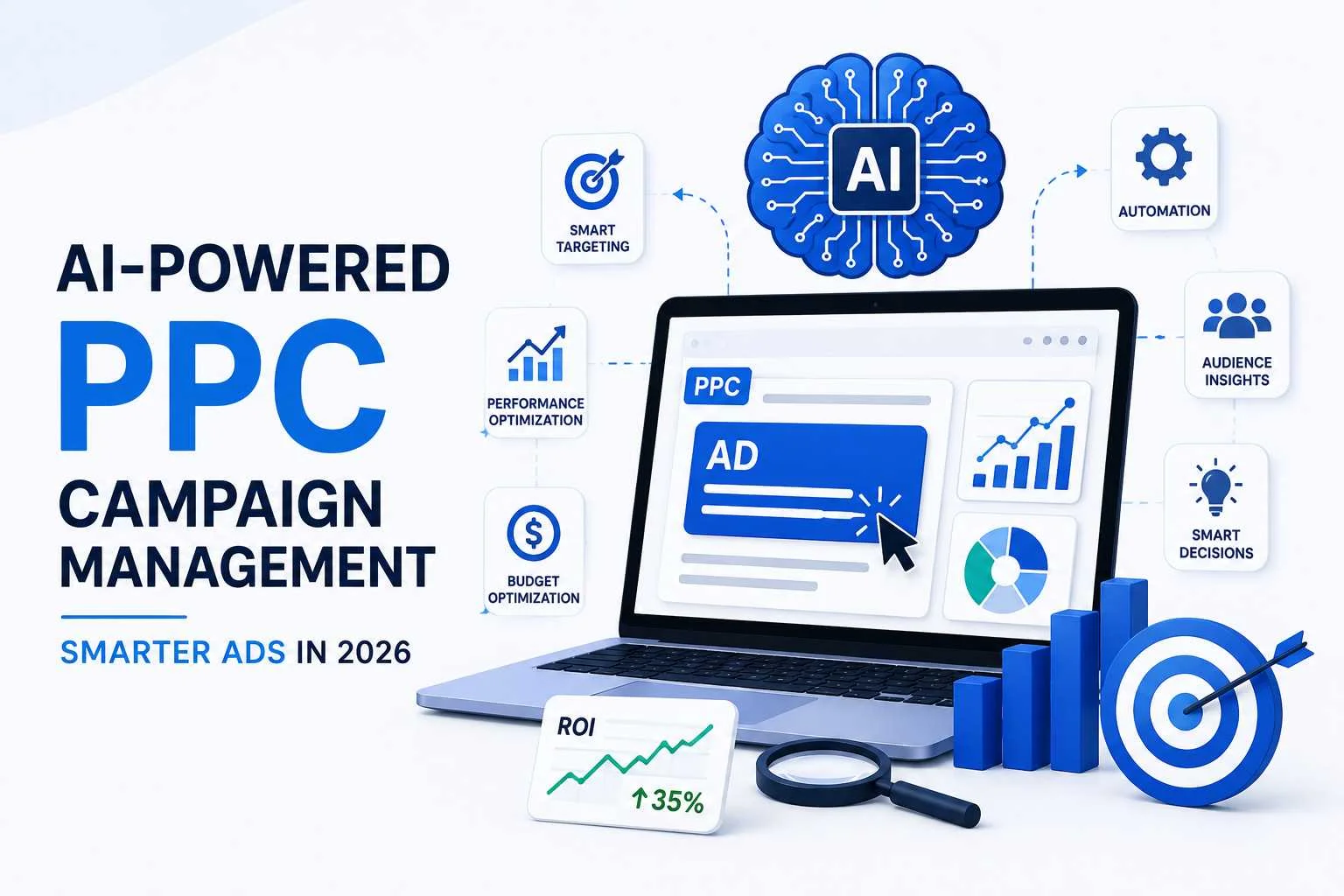
AI-Powered PPC Campaign Management: Smarter Ads in 2026
Introduction
Pay-Per-Click (PPC) advertising has long been one of the most effective ways for businesses to generate leads, increase website traffic, and drive sales. However, managing PPC campaigns successfully requires constant monitoring, keyword optimization, bid adjustments, audience targeting, and performance analysis. As competition grows and advertising platforms become more sophisticated, manual campaign management can be both time-consuming and challenging.
This is where Artificial Intelligence (AI) is transforming the PPC landscape. AI-powered PPC campaign management helps advertisers make smarter decisions using data, automation, and machine learning. Instead of relying solely on manual adjustments, businesses can use AI to optimize bids, identify high-performing audiences, improve ad performance, and maximize return on investment (ROI).
In this guide, we’ll explore how AI is changing PPC advertising, its benefits, challenges, and best practices for achieving better campaign results.
What is AI-Powered PPC Campaign Management?
AI-powered PPC campaign management refers to the use of artificial intelligence and machine learning technologies to automate and optimize various aspects of paid advertising campaigns.
AI can analyze large amounts of data in real time and make adjustments that help improve campaign performance.
Areas Where AI Helps
- Bid management
- Audience targeting
- Keyword optimization
- Ad creation
- Budget allocation
- Performance analysis
- Conversion prediction
The goal is to improve campaign efficiency while reducing manual effort.
Why AI is Becoming Essential in PPC Advertising
Modern PPC campaigns generate massive amounts of data daily. Analyzing this information manually can be difficult and often leads to missed opportunities.
AI Helps Marketers
- Process data faster
- Make informed decisions
- Improve campaign performance
- Reduce wasted ad spend
- Increase conversions
As advertising platforms continue to evolve, AI is becoming a valuable competitive advantage for businesses.
Key Benefits of AI-Powered PPC Campaign Management
Smarter Bid Optimization
One of the biggest advantages of AI is automated bidding.
AI analyzes factors such as:
- User behavior
- Device type
- Location
- Search intent
- Time of day
Based on this data, it adjusts bids automatically to maximize performance.
Benefits
- Better cost efficiency
- Improved conversion rates
- Reduced manual bid adjustments
This allows businesses to focus on strategy rather than constant bid monitoring.
Improved Audience Targeting
Reaching the right audience is critical for PPC success.
AI can analyze customer behavior patterns and identify users most likely to convert.
AI Uses Data Such As
- Search history
- Online behavior
- Interests
- Demographics
- Purchase intent
Benefits
- Higher-quality traffic
- Better lead generation
- Increased conversion opportunities
More accurate targeting often leads to improved campaign performance.
Better Budget Allocation
Many advertisers struggle with distributing budgets effectively across campaigns.
AI helps identify:
- Top-performing campaigns
- High-converting keywords
- Best-performing audiences
Advantages
- Reduced wasted spend
- Improved ROI
- Better resource utilization
The system can automatically shift budget toward the areas generating the best results.
Enhanced Ad Performance
AI can help improve ad effectiveness by analyzing user engagement data.
AI Can Assist With
- Ad copy suggestions
- Headline variations
- Call-to-action improvements
- Performance testing
Benefits
- Higher click-through rates (CTR)
- Better engagement
- Increased conversions
Continuous optimization helps ads remain competitive in crowded markets.
Faster Data Analysis
PPC campaigns generate large volumes of performance data.
Manually analyzing this information can take hours or even days.
AI Helps By
- Identifying trends quickly
- Detecting performance issues
- Highlighting optimization opportunities
- Generating actionable insights
This enables marketers to make faster and more informed decisions.
AI Features Commonly Used in PPC Campaigns
Modern advertising platforms already incorporate AI into many campaign settings.
Popular AI-Powered Features
- Smart Bidding
- Automated Budget Management
- Responsive Search Ads
- Audience Expansion
- Predictive Analytics
- Dynamic Search Ads
- Conversion Optimization
These features help businesses achieve better results with less manual effort.
How AI Improves Google Ads Campaigns
Smart Bidding Strategies
AI automatically adjusts bids based on conversion probability.
Examples Include
- Maximize Conversions
- Target CPA (Cost Per Acquisition)
- Target ROAS (Return on Ad Spend)
- Maximize Conversion Value
Responsive Search Ads
AI tests different combinations of:
- Headlines
- Descriptions
- Calls-to-Action
It then prioritizes the combinations most likely to perform well.
The Role of Predictive Analytics in PPC
Predictive analytics is one of AI’s most powerful capabilities.
It uses historical data to forecast future outcomes.
AI Can Predict
- Conversion likelihood
- Customer behavior
- Campaign performance
- Budget requirements
- Seasonal trends
Benefits
Businesses can make proactive decisions instead of simply reacting to campaign results.
Challenges of AI-Powered PPC Management
While AI offers many advantages, it is not a perfect solution.
Businesses should understand its limitations.
Over-Reliance on Automation
Some advertisers rely entirely on AI and stop monitoring campaigns.
Potential Risks
- Missed strategic opportunities
- Poor messaging alignment
- Reduced brand control
AI should support decision-making, not replace it completely.
Learning Period Requirements
AI systems require sufficient data before they can optimize effectively.
During Initial Stages
- Performance may fluctuate
- Results may be inconsistent
- Optimization may take time
Patience is important while algorithms gather and process data.
Limited Understanding of Brand Goals
AI focuses primarily on data and performance metrics.
However, it may not fully understand:
- Brand identity
- Customer emotions
- Business objectives
- Market positioning
Human oversight remains essential.
Data Quality Matters
AI is only as effective as the data it receives.
Poor Data Can Lead To
- Incorrect targeting
- Inefficient bidding
- Lower conversions
- Wasted budget
Accurate tracking and proper campaign setup are critical.
Success with AI-Powered PPC Campaign Management
Combine AI with Human Expertise
The most successful campaigns use a balance of automation and human strategy.
Let AI Handle
- Bid adjustments
- Data analysis
- Performance monitoring
- Audience targeting
Let Humans Handle
- Strategy development
- Creative direction
- Brand messaging
- Business decisions
This combination often delivers the best results.
Set Clear Campaign Goals
AI performs better when objectives are clearly defined.
Common PPC Goals
- Lead generation
- Website traffic
- Sales growth
- Brand awareness
- Customer acquisition
Clear goals help AI optimize campaigns more effectively.
Monitor Performance Regularly
Even automated campaigns require ongoing supervision.
Review Key Metrics
- Click-through Rate (CTR)
- Conversion Rate
- Cost Per Conversion
- Return on Ad Spend (ROAS)
- Quality Score
Regular reviews help identify opportunities for improvement.
Test and Refine Continuously
AI thrives on experimentation and learning.
Areas to Test
- Ad creatives
- Headlines
- Landing pages
- Audience segments
- Offers
Continuous testing often leads to stronger campaign performance.
Common Mistakes to Avoid
Many businesses fail to maximize AI because they use it incorrectly.
Avoid These Mistakes
- Trusting automation without oversight
- Ignoring campaign data
- Using poor-quality tracking
- Setting unclear goals
- Making frequent changes during learning periods
- Neglecting landing page optimization
- Focusing only on clicks instead of conversions
Avoiding these mistakes can significantly improve PPC results.
Key Takeaways
- AI is transforming PPC campaign management through automation and machine learning.
- Smart bidding helps optimize advertising spend.
- AI improves audience targeting and conversion opportunities.
- Predictive analytics helps forecast campaign performance.
- Automation saves time and increases efficiency.
- Human oversight remains critical for strategy and creativity.
- High-quality data is essential for successful AI optimization.
- Businesses should continuously monitor and refine campaigns.
Conclusion
AI-powered PPC campaign management is reshaping digital advertising by making campaigns smarter, faster, and more efficient. From automated bidding and audience targeting to predictive analytics and budget optimization, AI enables businesses to make data-driven decisions that improve campaign performance and maximize return on investment.
As PPC advertising becomes increasingly competitive, businesses that embrace AI-powered campaign management while maintaining strategic oversight will be better positioned to generate more leads, reduce advertising costs, and achieve long-term marketing success.