Digital Marketing ROI: How to Measure Success and Maximize Your Marketing Investment
Introduction
Digital marketing has become one of the most important growth strategies for businesses today. Companies invest in Search Engine Optimization (SEO), Google Ads, Social Media Marketing, Email Marketing, and Content Marketing to attract customers and increase sales.
But every business faces one important question:
Is my digital marketing investment actually delivering results?
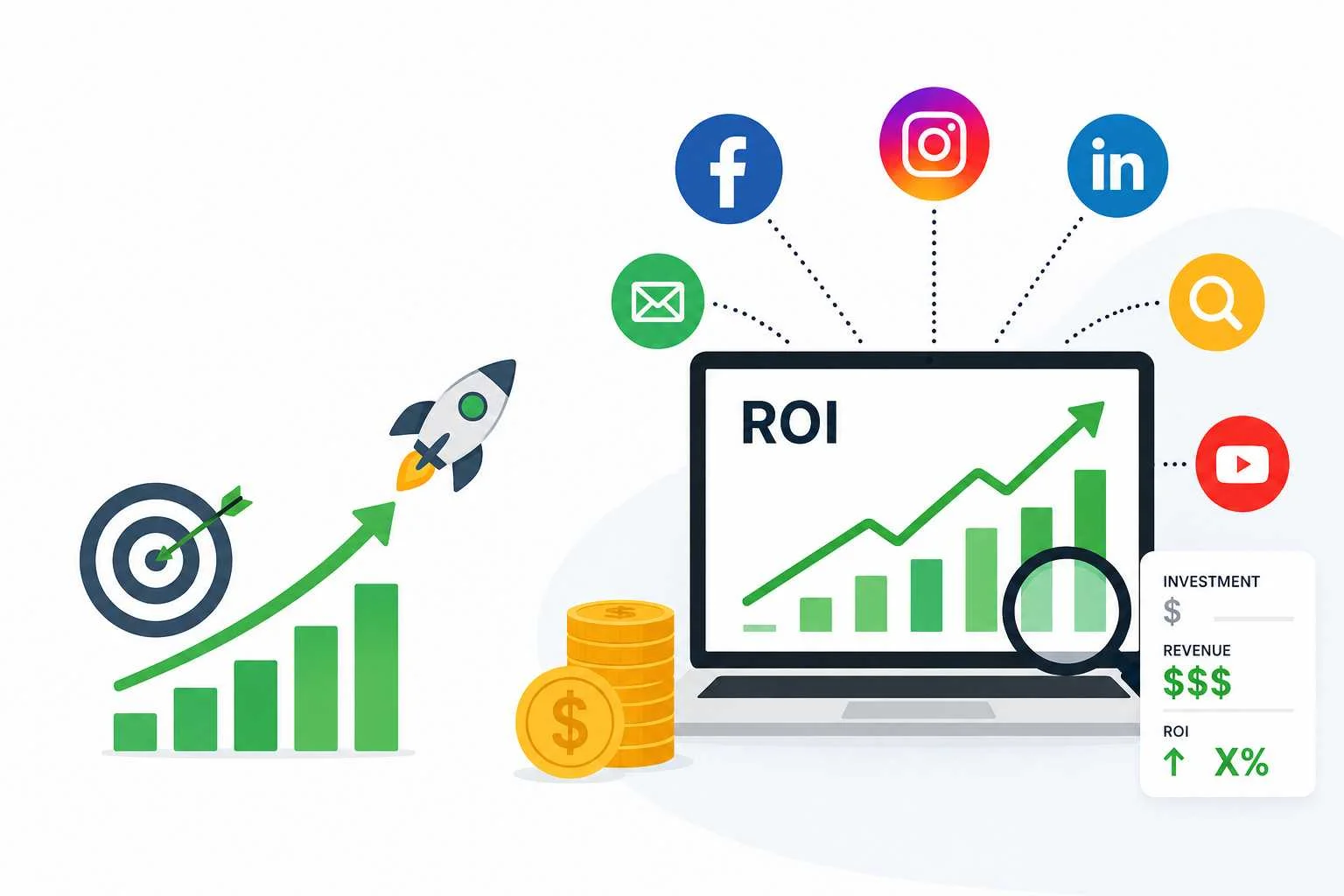
This is where Digital Marketing ROI (Return on Investment) becomes important.
Measuring digital marketing ROI helps businesses understand whether their marketing campaigns are generating revenue, increasing customer engagement, and contributing to business growth.
Without proper ROI measurement, businesses may spend money on strategies that do not deliver results. By tracking marketing performance, companies can make smarter decisions, optimize campaigns, and maximize their return on investment.
In this blog, we will explore what digital marketing ROI is, why it matters, how to calculate it, important metrics to track, and strategies to improve marketing performance.
What Is Digital Marketing ROI?
Digital Marketing ROI (Return on Investment) measures the profitability of your online marketing campaigns.
It compares the revenue generated from marketing activities with the total amount spent.
In simple words:
Digital Marketing ROI shows how much profit a business earns from every rupee invested in marketing.
A positive ROI means your campaigns are generating profit, while a negative ROI means the strategy needs improvement.
Why Is Digital Marketing ROI Important?
Many businesses focus on metrics like website traffic, social media followers, and impressions. While these numbers show activity, they do not always represent business success.
ROI measurement helps businesses:
- Identify the most effective marketing channels
- Improve marketing budget allocation
- Reduce unnecessary spending
- Increase campaign performance
- Understand customer acquisition costs
- Make data-driven decisions
- Improve overall profitability
Tracking ROI allows businesses to invest in strategies that create real value.
How to Calculate Digital Marketing ROI
The standard formula for calculating ROI is:
ROI = (Revenue Generated – Marketing Cost) ÷ Marketing Cost × 100
Example:
A business spends ₹50,000 on a digital marketing campaign and generates ₹2,00,000 in revenue.
Marketing Cost: ₹50,000
Revenue Generated: ₹2,00,000
Profit:
₹2,00,000 – ₹50,000 = ₹1,50,000
ROI:
300%
This means the business earned ₹3 for every ₹1 spent on marketing.
Key Metrics to Measure Digital Marketing Success
ROI is the main measurement of marketing success, but businesses should also track other important performance indicators.
1. Website Traffic
Website traffic measures the number of visitors coming to your website through different sources.
Common traffic sources include:
- Organic search
- Paid advertisements
- Social media platforms
- Email campaigns
- Referral websites
Increasing website traffic improves online visibility and creates more opportunities for conversions.
However, traffic alone does not guarantee sales.
2. Conversion Rate
Conversion rate measures the percentage of visitors who complete a desired action.
Examples include:
- Buying a product
- Filling out a form
- Requesting a quote
- Booking a service
- Subscribing to emails
Conversion Rate Formula:
Conversion Rate = (Conversions ÷ Visitors) × 100
A higher conversion rate shows that your marketing strategy is successfully turning visitors into customers.
3. Cost Per Lead (CPL)
Cost Per Lead measures how much money a business spends to generate a potential customer.
Formula:
CPL = Marketing Cost ÷ Number of Leads
Example:
Marketing Spend: ₹20,000
Leads Generated: 100
CPL: ₹200 per lead
A lower CPL indicates a more cost-effective marketing campaign.
4. Customer Acquisition Cost (CAC)
Customer Acquisition Cost measures the total cost required to gain a new customer.
Formula:
CAC = Total Marketing and Sales Cost ÷ Number of New Customers
Understanding CAC helps businesses determine whether acquiring customers is profitable.
5. Customer Lifetime Value (CLV)
Customer Lifetime Value estimates the total revenue a customer can generate throughout their relationship with a business.
A successful marketing strategy focuses on increasing customer lifetime value while reducing acquisition costs.
When:
CLV is higher than CAC
the business has stronger growth potential.
6. Click-Through Rate (CTR)
Click-Through Rate measures how many users click on an advertisement, email, or search result.
Formula:
CTR = (Clicks ÷ Impressions) × 100
A strong CTR indicates that your message and audience targeting are effective.
7. Return on Ad Spend (ROAS)
Return on Ad Spend measures the effectiveness of paid advertising campaigns.
Formula:
ROAS = Revenue From Ads ÷ Advertising Cost
Example:
Revenue: ₹1,00,000
Advertising Cost: ₹20,000
ROAS: 5
This means the campaign generated ₹5 for every ₹1 spent on advertising.
Measuring ROI Across Different Digital Marketing Channels
SEO (Search Engine Optimization)
ROI can be measured using:
- Organic traffic growth
- Keyword rankings
- Search visibility
- Leads generated
- Revenue from organic search
SEO provides long-term benefits because optimized content can continue attracting visitors over time.
Google Ads and PPC Marketing
Important PPC ROI metrics include:
- Cost per click (CPC)
- Click-through rate (CTR)
- Conversion rate
- Cost per lead
- ROAS
Paid advertising provides quick results and measurable performance data.
Social Media Marketing
Social media ROI can be measured through:
- Engagement
- Reach
- Website traffic
- Leads
- Sales conversions
Businesses should focus on revenue-driven results instead of only likes and followers.
Email Marketing performance can be tracked through:
- Open rate
- Click-through rate
- Conversion rate
- Revenue generated
Email marketing often provides strong returns when campaigns are personalized.
Content Marketing
Content marketing ROI can be measured using:
- Website traffic
- Search rankings
- Time spent on pages
- Lead generation
- Conversions
Quality content helps businesses attract, educate, and convert customers.
Tools to Measure Digital Marketing ROI
Google Analytics
Google Analytics is used for tracking:
- Website visitors
- User behavior
- Traffic sources
- Conversions
Reporting Dashboard
Helps monitor:
- Advertising costs
- Clicks
- Campaign performance
- Conversions
Google Search Console
Tracks:
- Keyword performance
- Search rankings
- Organic visibility
CRM Software
Connects marketing campaigns with sales results.
Using proper tools helps businesses measure ROI accurately.
Challenges in Measuring Digital Marketing ROI
Multiple Customer Touchpoints
Customers often interact with different marketing channels before purchasing.
For example:
A customer may discover a brand through social media, search on Google, and finally purchase through email.
Long Sales Cycles
Some industries require more time to convert leads into customers.
Poor Tracking Systems
Without proper analytics setup, businesses may lose important performance data.
Vanity Metrics
Likes, followers, and impressions may look valuable but do not always generate revenue.
How to Improve Digital Marketing ROI
Set Clear Goals
Define measurable marketing objectives such as:
- Increasing sales
- Generating leads
- Improving conversions
- Reducing acquisition costs
Focus on High-Performing Channels
Invest more budget into strategies that consistently generate positive results.
Improve Landing Pages
Optimize:
- Page speed
- User experience
- Content quality
- Call-to-action buttons
Better landing pages improve conversions.
Improve Audience Targeting
Reach the right customers based on:
- Interests
- Behaviour
- Needs
- Buying intent
Test and Optimize Campaigns
Regularly test:
- Ad copy
- Keywords
- Headlines
- Landing pages
- Offers
Continuous improvement leads to better ROI.
Common Digital Marketing ROI Mistakes to Avoid
Businesses should avoid:
- Not tracking conversions
- Measuring only traffic
- Ignoring customer lifetime value
- Spending without clear goals
- Not reviewing campaign performance
- Focusing only on vanity metrics
Proper measurement helps businesses make smarter marketing decisions.
Future of Digital Marketing ROI Measurement
The future of ROI tracking will be powered by advanced technologies such as:
- AI-powered analytics
- Predictive marketing insights
- Automated reporting
- Advanced attribution models
- Real-time dashboards
These technologies will help businesses understand customer behaviour and improve marketing efficiency.
Conclusion
Digital Marketing ROI is one of the most important factors for measuring marketing success. It helps businesses understand which campaigns generate revenue and where investment should be increased.
By tracking important metrics such as conversion rate, customer acquisition cost, ROAS, and customer lifetime value, businesses can improve their Digital marketing strategies and maximize profitability.
The goal of digital marketing is not just spending more money but investing wisely, measuring results, and continuously optimizing campaigns.
Businesses that focus on ROI-driven marketing strategies can achieve sustainable growth, stronger customer relationships, and long-term success.
Frequently Asked Questions (FAQs)
What is Digital Marketing ROI?
Digital Marketing ROI measures the profit generated from online marketing campaigns compared to the cost invested.
Why is ROI important in digital marketing?
ROI helps businesses understand which strategies are working and where marketing budgets should be spent.
What is a good digital marketing ROI?
A positive ROI indicates profitability. The ideal ROI depends on business goals and industry.
Which digital marketing channel gives the best ROI?
SEO and Email Marketing often provide strong long-term returns, while PPC delivers faster measurable results.
How often should businesses measure ROI?
Businesses should review ROI regularly, such as monthly, quarterly, and yearly.